
Full Moon Party Thailand: 40 Years and Evolving
About fullmoonparty-thailand.com
This site has been the main information hub for the Full Moon Party since 2004, with direct contacts in the Haad Rin Business Association on Ko Phangan. Party dates, schedule changes, and entry information are updated here through those connections after every party. We have covered every Full Moon Party for over 20 years.
Our team includes people who attended the early parties in the late 1980s and early 1990s, long-term residents of Koh Phangan, and travelers who have been to dozens of Full Moon Parties.
The schedules, safety tips, transport routes, and accommodation picks on this site come from direct experience, not aggregated from other websites.
For practical questions, see the full guide, transport info, or accommodation picks.
Here is the Full Story of the Full Moon Party
The Journey to Paradise: From the Hippie Trail to Thailand's Shores
In the 1960s and throughout the 1970s, a generation of young Europeans embarked on transformative journeys eastward, driving beaten-up cars, painted vans, and dusty motorcycles along the legendary Hippie Trail to India. Some traveled with nothing but a backpack, hitchhiking across continents in search of enlightenment, adventure, and connection. These wanderers converged in the ashrams of Rishikesh, the beaches of Goa, and the mountain valleys of Nepal, creating spontaneous communities united by music, spiritual exploration, and a shared rejection of conventional lifestyles. The journey itself became a rite of passage, a months-long odyssey through Turkey, Iran, Afghanistan, and Pakistan that promised both danger and transcendence.
Herbert, a German traveler from that era told us: "I went all the way to Afghanistan with this 'Ente' car that had a mere 20 horsepower. It was enough for that long journey. An absolute classical experience and I met so many friendly locals and other travellers on the way. We'd camp under the stars in the desert and share meals with local families. It wasn't just about reaching India. Every kilometer was part of the spiritual journey."
When Paradise Shifted East
By the late 1970s, the overland route to this mythical Shangri-La had become increasingly dangerous and then impossible. The Iranian Revolution of 1979, followed by the Iran-Iraq War and the Soviet invasion of Afghanistan, broke up the Hippie trail to India. As beloved gurus like Osho relocated their ashrams to the USA and other Western locations, and as political instability made the traditional route impassable, seekers needed a new destination.
Simultaneously, air travel was becoming more affordable so that paradise could be reached in hours rather than months, and the search for transformative experiences expanded beyond the Indian subcontinent into Southeast Asia.
Thailand's Emergence as the New Frontier
Thailand emerged as an unexpected home for these seekers of connection, pleasure and spirituality. The Kingdom of Thailand already welcomed a lot of US soldiers for R&R leaves that established famous and infamous tourist centers. Partly on those same trails and partly avoiding the likes of Pattaya and Bangkok, the backpackers sought out to explore further.
Thailand's political stability, Buddhist culture, tropical beauty, and the legendary Thai hospitality, created perfect conditions for a new kind of traveler. As the soldiers departed in the mid-1970s, backpackers began arriving, finding in Thailand's golden temples, pristine beaches, and mist-covered mountains a new canvas for their dreams of alternative living.
The Backpacker Network Takes Root
By the mid-1980s, Thailand's backpacker scene had evolved into a sophisticated underground network. Khao San Road in Bangkok became the nerve center of this new lifestyle. It is a street where travelers exchanged copies of Lonely Planet guides, shared tips about hidden waterfalls, and debated the best routes through the Golden Triangle. Guesthouses and hostels functioned as crucial information exchanges, their bulletin boards covered with hand-drawn maps to secret beaches, warnings about police checkpoints, and invitations to join others heading south.
This new generation split into tributaries across the kingdom: some headed north to trek among hill tribes in Chiang Mai and Chiang Rai, others went south to climb the limestone karsts of Krabi, and many island-hopped through the Gulf of Thailand.
The Birth of a Lunar Celebration
It was on Koh Phangan, a small island with a population of a few hundred, neighboring the more developed Koh Samui, where something began to emerge. (Source: TIME)
In the mid-to-late 1980s, small groups of locals and travelers started gathering on Haad Rin beach during full moons, drawn by the otherworldly beauty of moonlight on water and the primal urge to celebrate beneath the stars. These early gatherings were entirely organic. No promoters, no official organization, just word-of-mouth passed between hostels and bars. Someone would bring a guitar, another would have a cassette player, and as the moon rose full and bright over the Gulf of Thailand, a few dozen souls would dance on the sand until dawn.
By the early 1990s, these impromptu celebrations had grown through the invisible networks of backpacker communication into gatherings of hundreds, with travelers timing their Thai journeys specifically to arrive at Haad Rin when the moon was full.
The Full Moon Party wasn't created; it emerged, a spontaneous ritual born from the convergence of place, time, and a generation still searching for transcendence.
From Spontaneous Gathering to Organized Phenomenon
As the 1990s progressed, what had begun as spontaneous beach gatherings gradually evolved into something more structured, though never fully formalized.
The local business community of Haad Rin, recognizing both the opportunity and the need for coordination, formed a loose organization to manage the growing event. The Full Moon Party however, remained a decentralized celebration, with dozens of beachfront bars, restaurants, and guesthouses each contributing their own sound systems, decorations, and unique flavors to the night. One Bungalow place might host trance DJs, while another Bar specialized in fire shows, and a Club pumped out hip-hop, creating a mosaic of experiences along the crescent beach. This is stil this way.
The Power of Traveler Networks and Media
Throughout the 1990s, the Full Moon Party's growth remained driven by travelers themselves, who became its most passionate ambassadors.
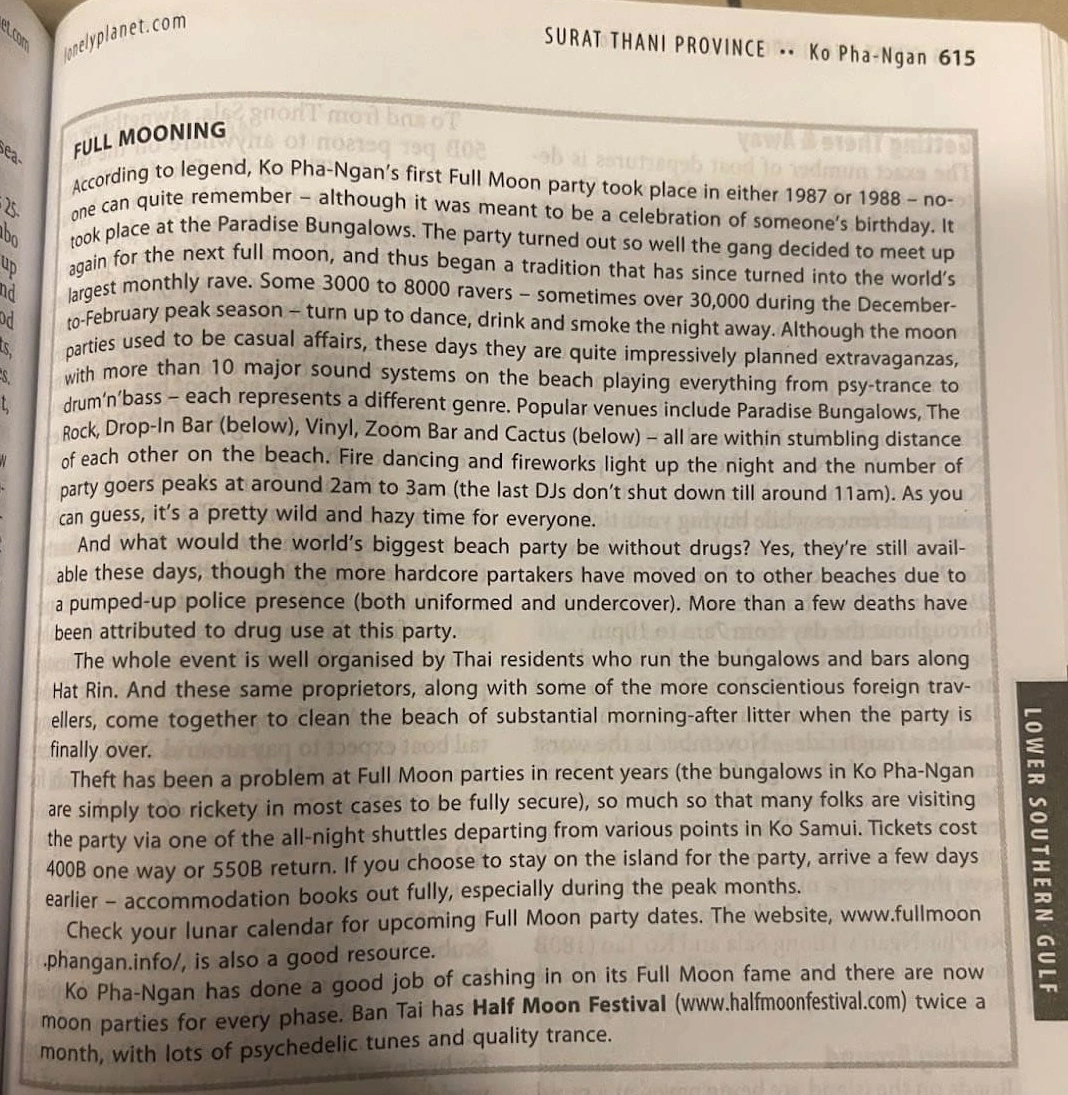
Backpackers would plan entire Southeast Asian journeys around the lunar calendar, and stories of epic full moon nights became legendary in hostels from Kathmandu to Bali. The party's mythology spread through a thousand conversations in infamous dive bars and on bus rides. When guidebooks like Lonely Planet, The Rough Guide, and Footprint finally documented the phenomenon, they were merely codifying what the backpacker telegraph had been transmitting for years. These publications transformed the Full Moon Party from an insider secret to a must-do experience on the Southeast Asian trail.
By the late 1990s, what had once been gatherings of hundreds had exploded into celebrations of thousands, with travelers from every corner of the globe converging on Haad Rin's beach when the moon was full.
The Digital Revolution and Full Moon Party Thailand's Birth
The early 2000s brought the internet age to backpacker culture, fundamentally transforming how travelers discovered and shared experiences.

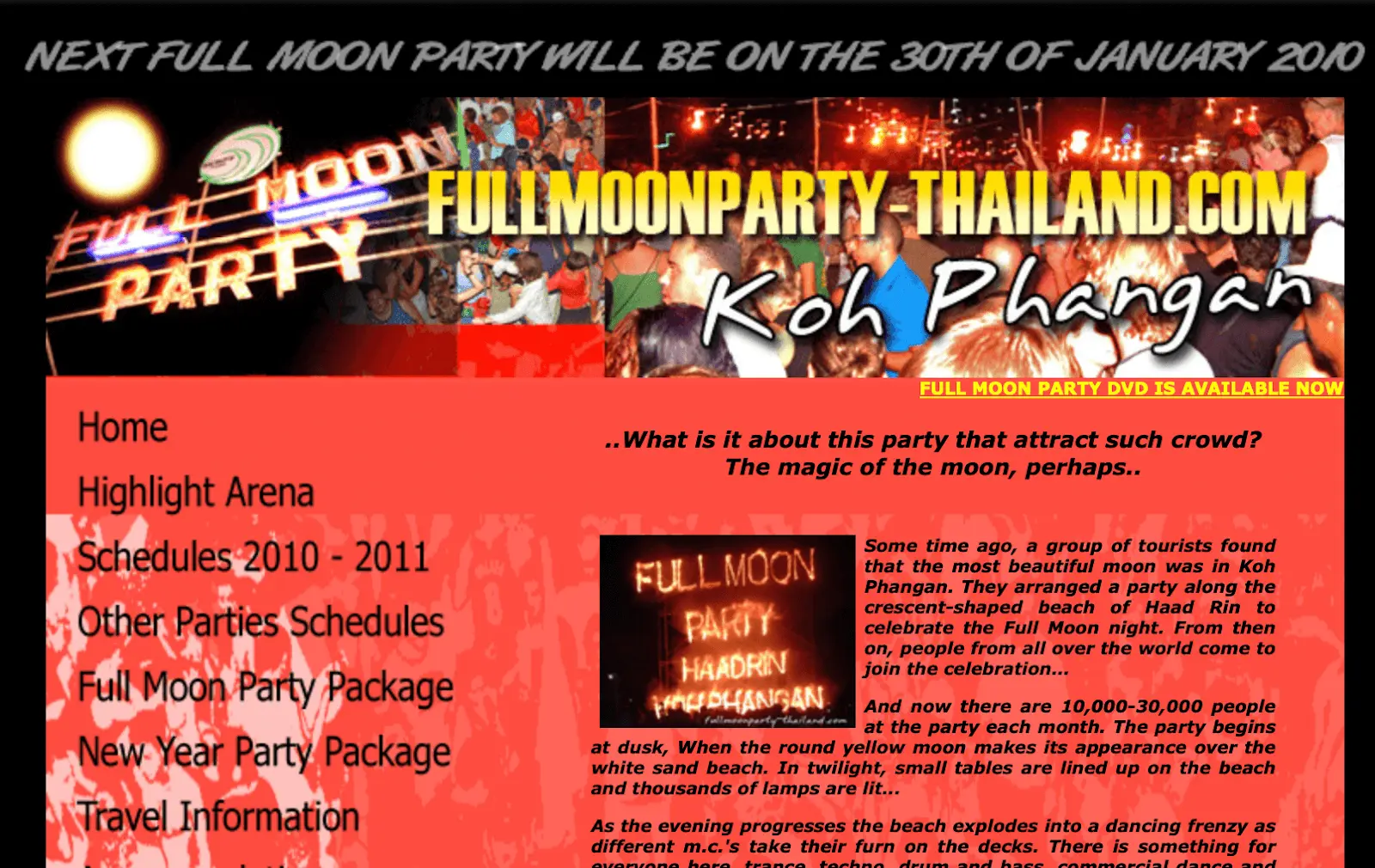
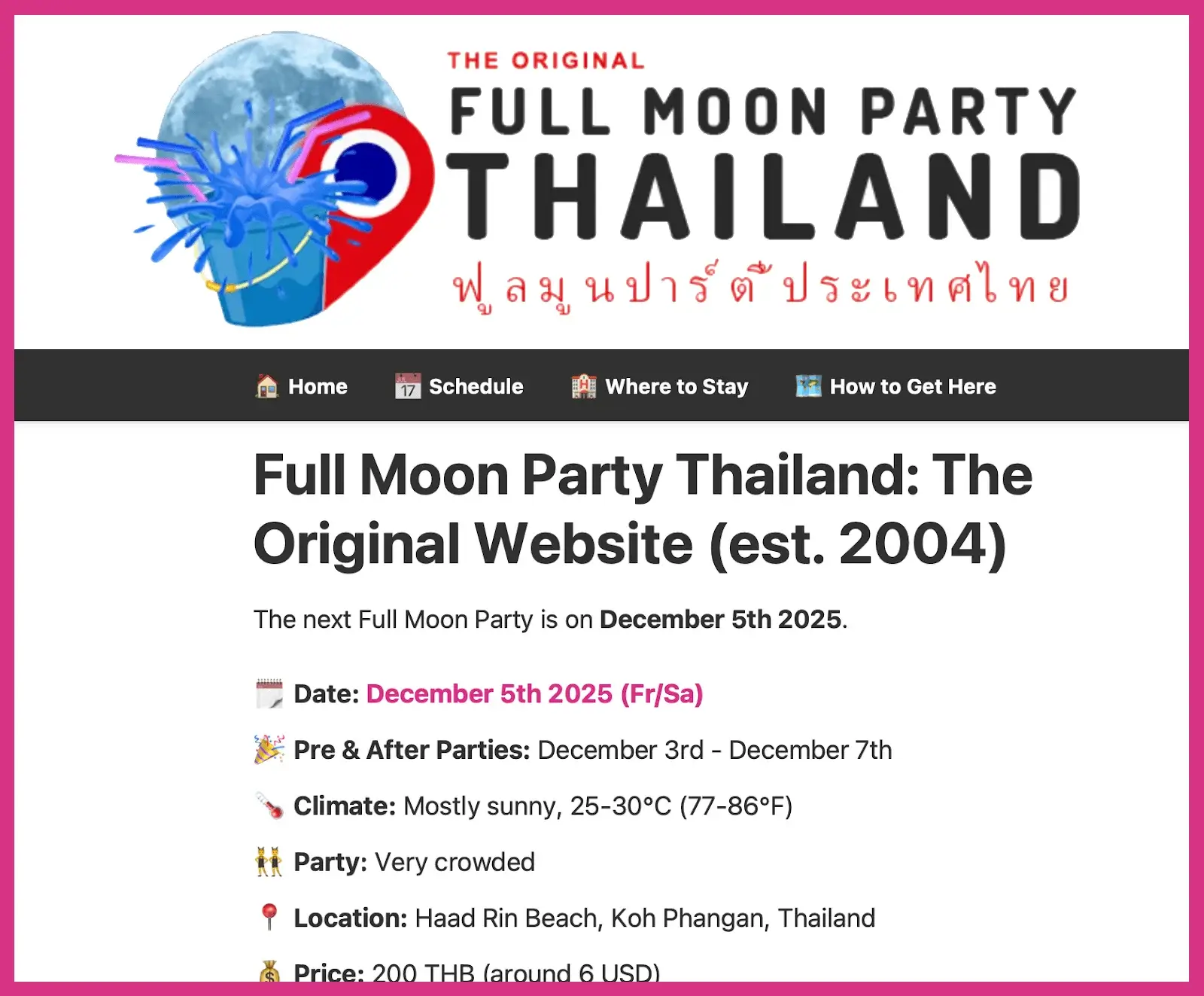
In the early 2000s, a group of passionate travelers who had fallen in love with the Full Moon Party created the idea of fullmoonparty-thailand.com and launched this very website in 2004.
The idea was two-fold: Bring the information from the physical bulletin boards of hostels to the internet and provide first hand information from travelers and bar owners running the party to the world in a centralized way as well as preserving the original ideas of participation, openness, and spontaneous gathering without burdening it with bureaucracy.
The website became the virtual embodiment of those countless conversations, offering practical advice on everything from ferry schedules to safety tips, party dates to accommodation recommendations. This wasn't corporate marketing but the compilation of what backpackers from the late 1980s onwards shared in terms of vision, enthusiasm and practical advice. Just in a completely digital form.
The impact was immediate and profound: attendance at some parties soared past 10,000, then 20,000, as travelers could now plan their Full Moon Party experience months in advance from internet cafes in Bangkok or from their homes halfway around the world.
The Social Media Explosion
About a decade later, in the 2010s the social media revolution picked up steam with Facebook's rising popularity, transforming the Full Moon Party from a phenomenon in which word-of-mouth and immediacy was compiled by this website to a globally broadcast spectacle
Instagram stories, Facebook events, and YouTube videos replaced dusty guidebooks as primary sources of inspiration. Suddenly, the party wasn't just experienced. It was performed for audiences thousands of miles away. Hashtags like #fullmoonparty generated millions of posts, each sunset selfie and fire-jumping video drawing more curious souls to Koh Phangan.
The website fullmoonparty-thailand.com evolved alongside these platforms, maintaining its role as the trusted source for practical information while social channels handled the visual storytelling.
This digital amplification pushed attendance to unprecedented levels, with some parties drawing over 30,000 revelers to Haad Rin's beach, a small city materializing for one night under the tropical moon.
Along the way, we got featured in several different travel publications:

The downside is of course that many people spend more time on their phones being on life streams than experiencing the immediacy of the event. In the 2010s, other events emerged on different dates like the Eden festival that caters more to a clubbing crowd that prefers no phones and other, more centralized commercial events as well. Still, the original Full Moon Party is the biggest magnet and all other events are centered around this distributed experience.
In the 2010s, other destinations also started to hold their own Full Moon Parties and some reached sizable audiences, while still not reaching anywhere near what happens on Koh Phangan.

Disruption and Evolution in the 2020s
The 2020s brought seismic shifts that tested the Full Moon Party's resilience.
COVID-19 accomplished what decades of monsoons and political upheavals couldn't: it stopped the party completely. Haad Rin fell silent, its bars shuttered, the beach emptied.
Earlier, in October 2016, the death of King Bhumibol Adulyadej had led to a respectful pause in celebrations as Thailand entered a period of national mourning, demonstrating how deeply the party had become interwoven with its Thai context.
When the party finally returned post-pandemic, it came back transformed. Attendance exploded beyond all previous records, with some events drawing up to 60,000 people (double the peak pre-COVID numbers).
The Haad Rin Business Association, facing infrastructure and safety challenges from these massive crowds, introduced an entrance fee to the beach area for the first time in the party's history. Yet even with this change, the Full Moon Party retained its decentralized character as dozens of venues still create their own unique atmospheres, from psychedelic trance temples to reggae beaches to techno caves.
A Shifting Global Mosaic
The demographics of the Full Moon Party have continuously evolved, creating an ever-changing portrait of global youth culture. The original crowds of the 1980s, predominantly Western Europeans, Australians, and Americans seeking countercultural experiences, gave way to new waves of seekers. The 1990s and 2000s saw massive influxes of Russian and Israeli travelers, often arriving after military service seeking release and transformation. The 2020s have witnessed perhaps the most dramatic shift yet: Indian travelers now form one of the largest contingents, their presence reflecting India's growing middle class and changing attitudes toward international travel. The beach now hosts increasing numbers of visitors from the Arab world, Pakistan, and Japan, while Thai nationals have begun embracing what was once seen as a purely foreign phenomenon. Surprisingly, despite Thailand receiving millions of Chinese tourists annually, the Full Moon Party remains relatively undiscovered by travelers from China, one of the last major markets yet to embrace this celebration.
The Continuing Mission
Through all these transformations, fullmoonparty-thailand.com has remained true to its founding vision, serving as the traveler-created, traveler-maintained gateway to the Full Moon Party experience.
From its launch in 2004 through today's integration with social media platforms, the website continues the tradition that began with those first hostel bulletin boards in the 1980s.
The Full Moon Party Council brings together travelers, expatriates, and long-term residents of Ko Phangan who have been attending and documenting the party for decades. The council coordinates date verification, safety information, and practical guidance, ensuring newcomers get accurate information directly from people who know the party.
2025: Return to the Roots
In November 2025, the Full Moon Party faced an unexpected test of its fundamental character. The Haad Rin Business Association officially cancelled the organized party following the death of the Queen Mother, a decision reflecting appropriate cultural respect.
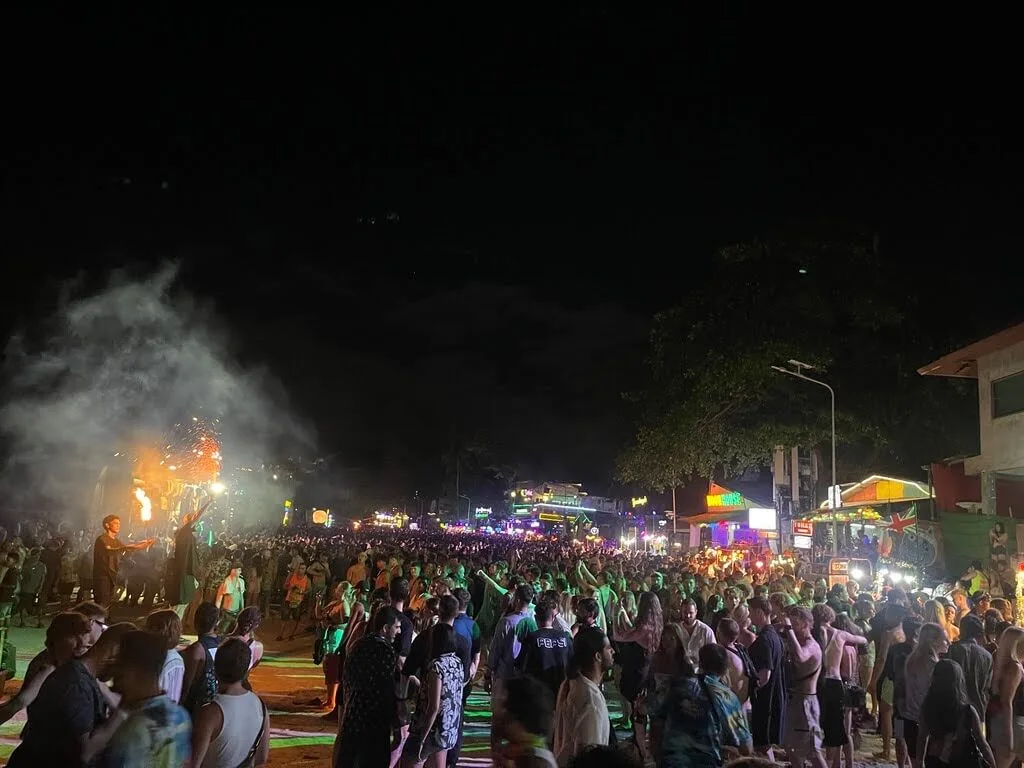
Yet in a powerful demonstration of the party's true nature, over 5,000 travelers still made their way to Haad Rin beach on the full moon night. Without official organization, there was still a lot going on by bars, clubs and hotels using their sound systems, and travelers promoting the event in a grassroots way. Travelers created their own celebration. It was smaller and more modest, but meaningful and respectful to local culture.
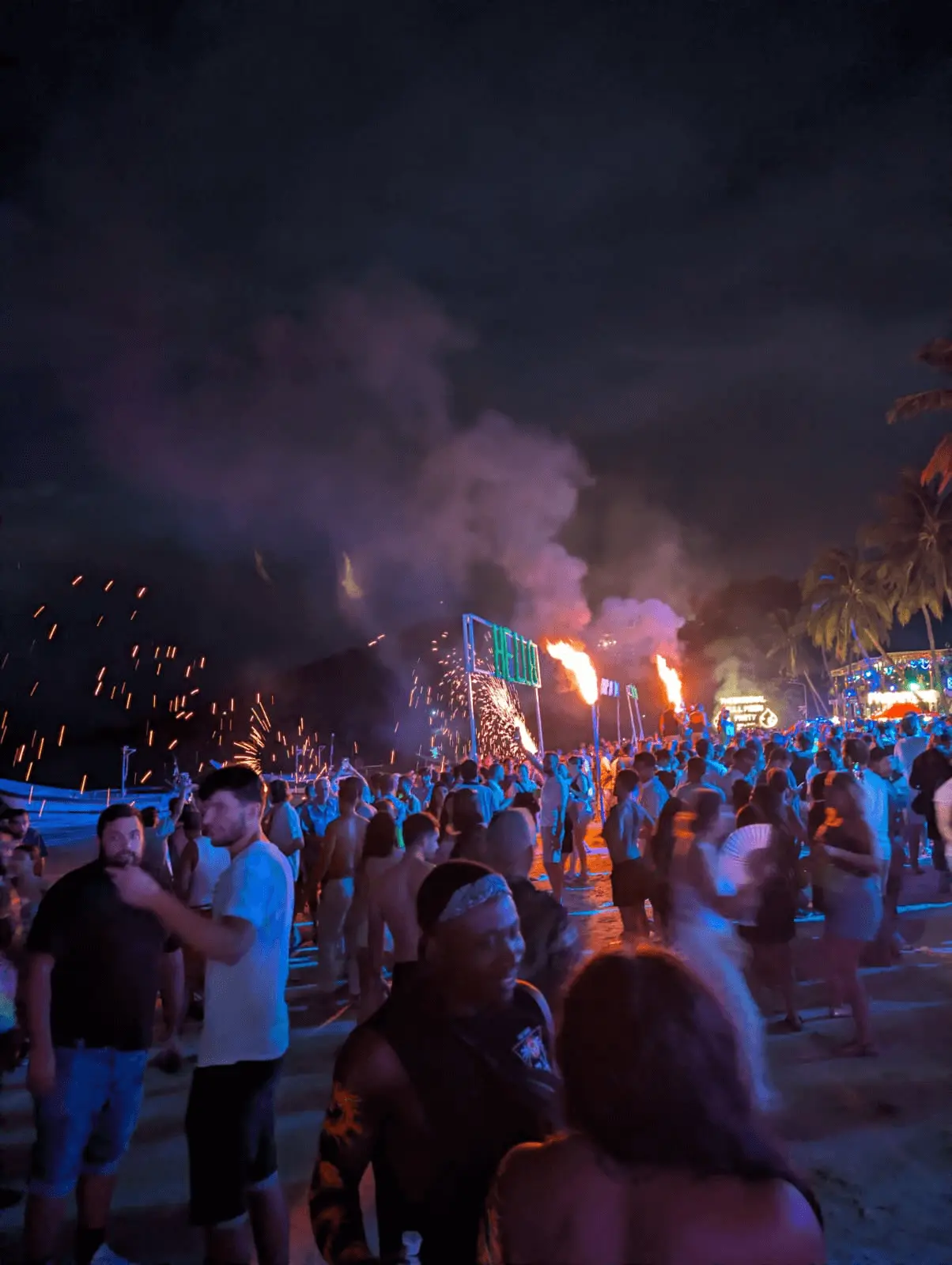
Photo from November 2025 when the “official party” did not happen (thanks to @twospiritedtraveler).
You judge for yourself and get the info from our email newsletter:
Beach bars played music at respectful volumes, fire dancers performed for small circles rather than massive crowds, and strangers shared speakers and drinks as they had forty years ago.
This spontaneous gathering proved that the Full Moon Party exists beyond any official organization. It lives in the collective spirit of travelers who understand that some experiences can't be cancelled, only transformed. The November 2025 party was both a return to the intimate gatherings of the 1980s and a glimpse of the party's future: resilient, adaptable, and forever belonging to the global community of seekers who create it anew with each full moon.